

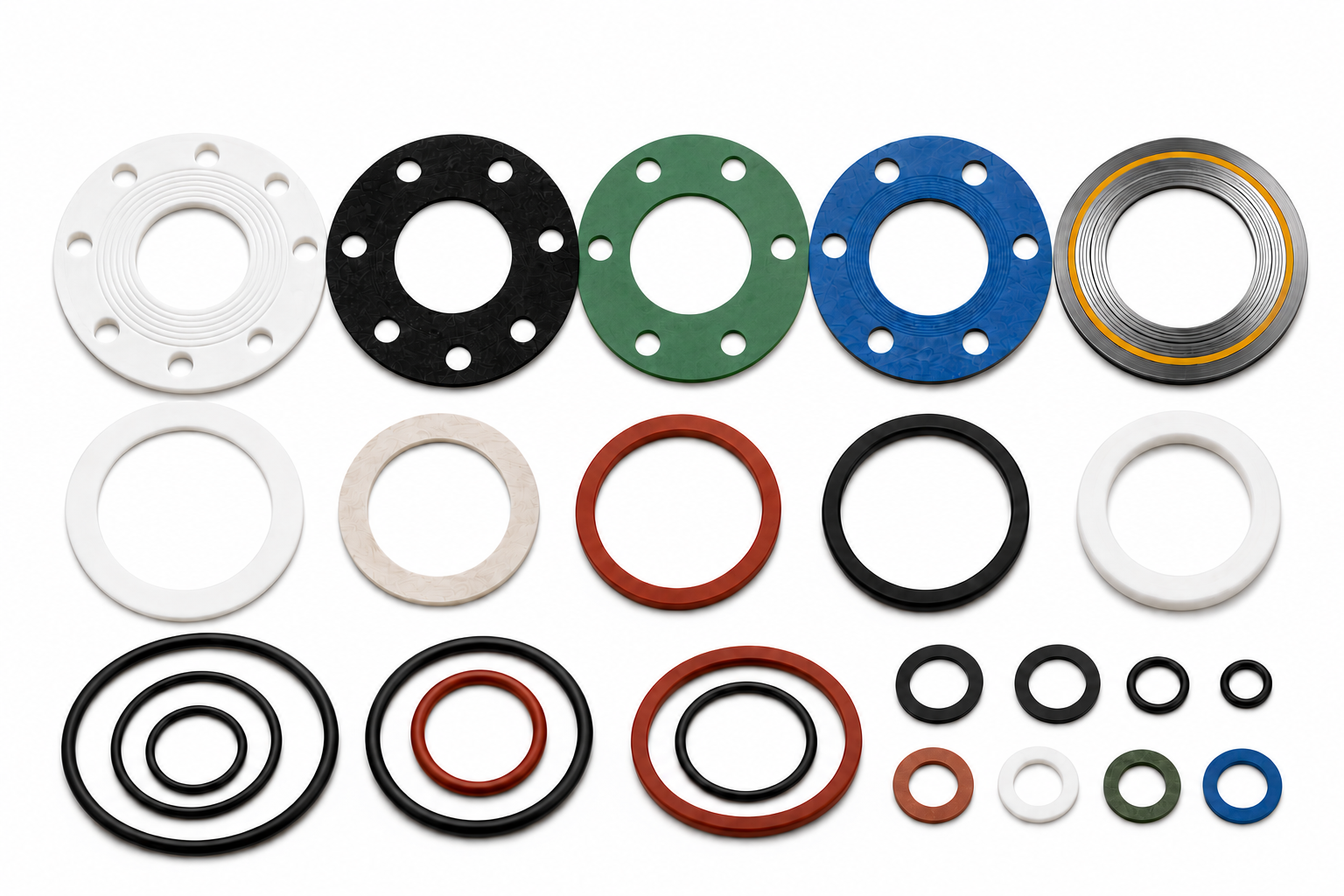
Seals
Seals are mechanical devices used to prevent leakage of fluids (liquids or gases) between two surfaces in rotating or stationary equipment. They are essential for maintaining pressure, preventing contamination, and ensuring safe operation of pumps, compressors, turbines, mixers, and other machinery.
Purpose of Seals
- Prevent leakage — Keep process fluids inside equipment.
- Prevent contamination — Stop external dirt or air from entering.
- Maintain pressure — Essential for vacuum systems and pressurized equipment.
- Protect equipment — Reduce wear and prevent corrosion.
Types of Seals
1 Gland Packing / Rope Seal
- Soft material (graphite, PTFE, or hemp) packed around a shaft.
- Compressed with a gland to form a seal.
- Used in pumps and mixers.
Advantages
Simple, low cost
Disadvantages
Requires maintenance, leaks slightly
PTFE Gasket
A PTFE Gasket is a sealing element made from Polytetrafluoroethylene (PTFE, commonly known as Teflon). It is widely used in chemical, pharmaceutical, and food industries due to its excellent chemical resistance, high temperature tolerance, and non-stick properties.
Features of PTFE Gaskets
- MaterialPolytetrafluoroethylene
- Temperature Range−200°C to +260°C (depending on grade)
- Pressure RangeModerate to high (depending on thickness and flange design)
- Chemical ResistanceResistant to almost all acids, bases, solvents, and aggressive chemicals
- ElasticityLow, requires proper flange tightening for sealing
- Non-stickReduces fouling and buildup on the sealing surface
Types of PTFE Gaskets
1 Solid PTFE Gasket
- Made entirely of PTFE sheet
- Excellent chemical resistance
- Used in flange connections with clean, non-abrasive fluids
2 Filled PTFE Gasket
- PTFE mixed with fillers like glass, carbon, or graphite
Interested in PTFE Gasket & O-ring ?
Contact our team for specifications, pricing, and availability.