
Vacuum Pump Types — In Detail
Each vacuum pump technology has a unique operating principle, performance range, and ideal application. Select a pump type to explore its working, components, and specifications.
Liquid Ring Vacuum Pump
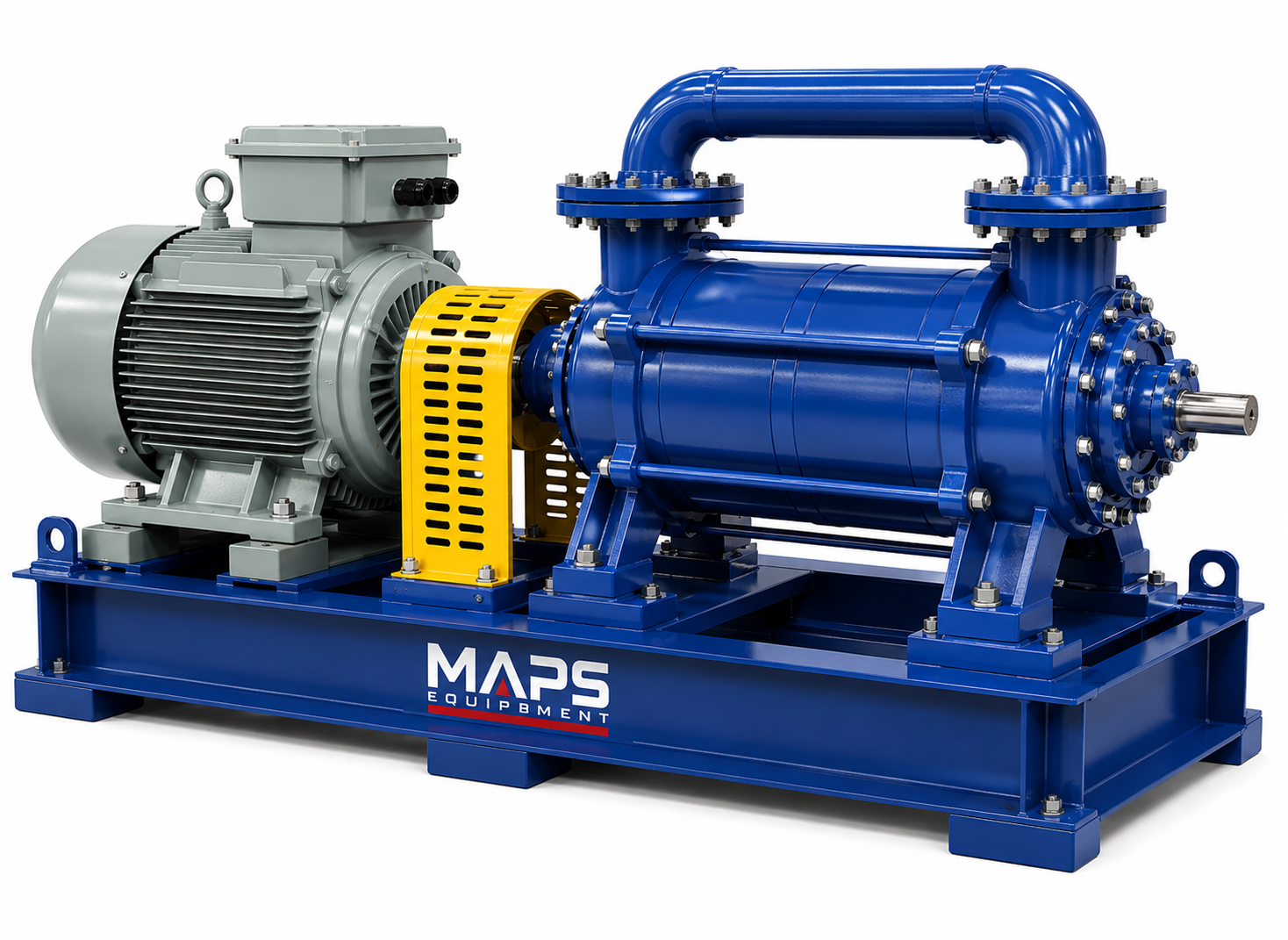
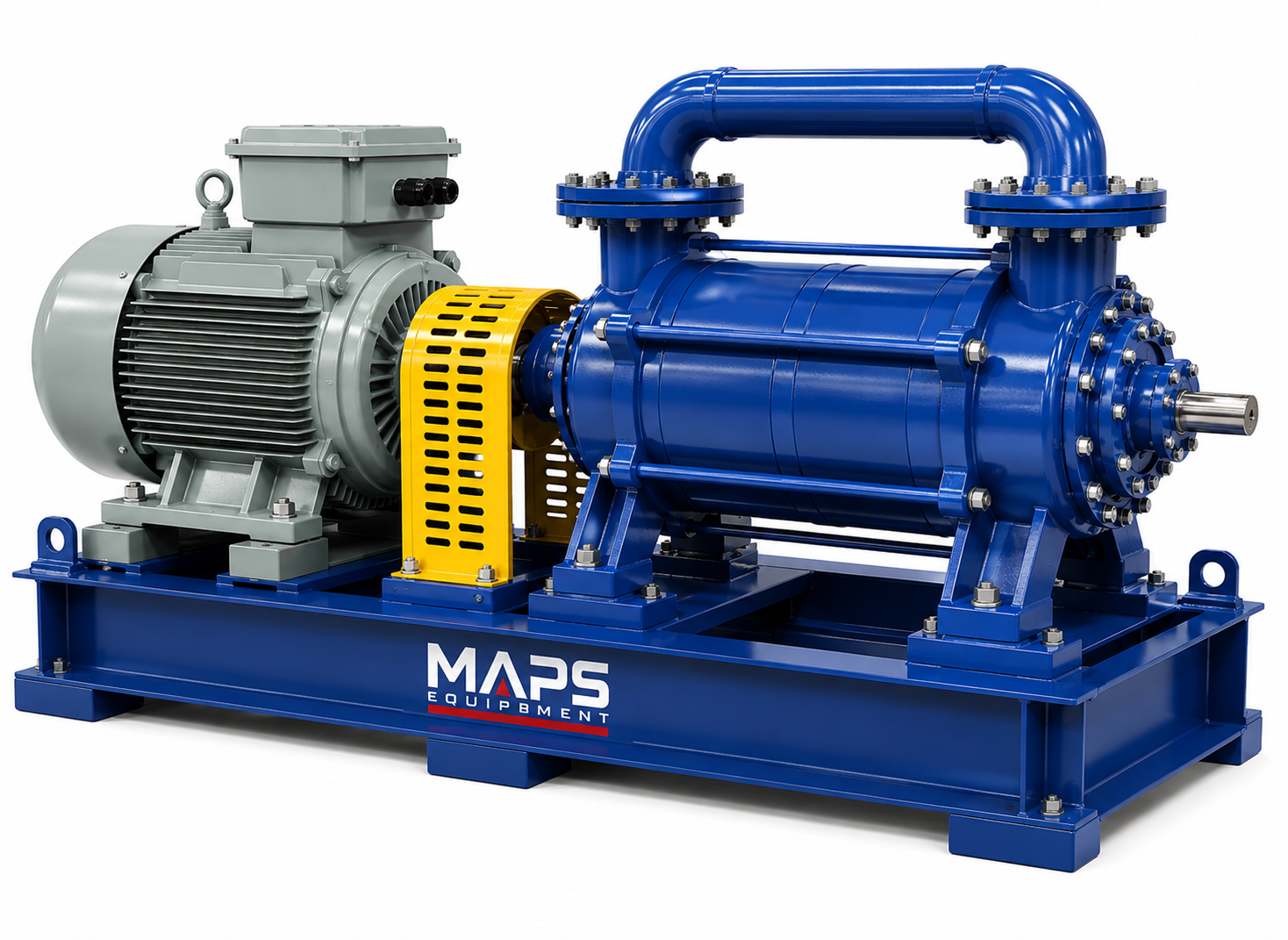
Uses a rotating liquid ring (water or oil) inside an eccentric casing to trap, compress, and discharge gas. Highly robust and capable of handling wet, humid, or contaminated gases without damage.
Advantages
- ✔Handles wet, saturated, or dirty gases
- ✔Smooth, low-vibration operation
- ✔Continuous duty capable
- ✔Simple, robust construction
- ✔Suitable for hazardous environments
Limitations
- ✖Requires continuous sealing liquid supply
- ✖Slightly lower ultimate vacuum vs dry pumps
- ✖Liquid disposal if contaminated
Key Parameters
Working Principle — Step by Step
- 1
The cylindrical rotor is mounted off-center inside a casing partially filled with liquid.
- 2
As the rotor spins, centrifugal force throws the liquid outward, forming a rotating ring along the casing wall.
- 3
The liquid ring creates variable-volume cavities between rotor vanes — larger at inlet, smaller at outlet.
- 4
Gas enters through the inlet and is trapped in the expanding cavities, then compressed as cavities shrink.
- 5
The compressed gas-liquid mixture is discharged through the outlet port.
- 6
The sealing liquid is separated and recycled or replaced with fresh liquid supply.
Typical Applications
Vacuum Distillation
Separation of temperature-sensitive compounds under reduced pressure.
Evaporation
Concentration of liquid foods and beverages without heat degradation.
Drying
Pharmaceutical vacuum drying of heat-sensitive active ingredients.
Pulp Processing
Dewatering and forming in paper and pulp manufacturing lines.
Liquid Ring Pump — Closed-Loop Cycle
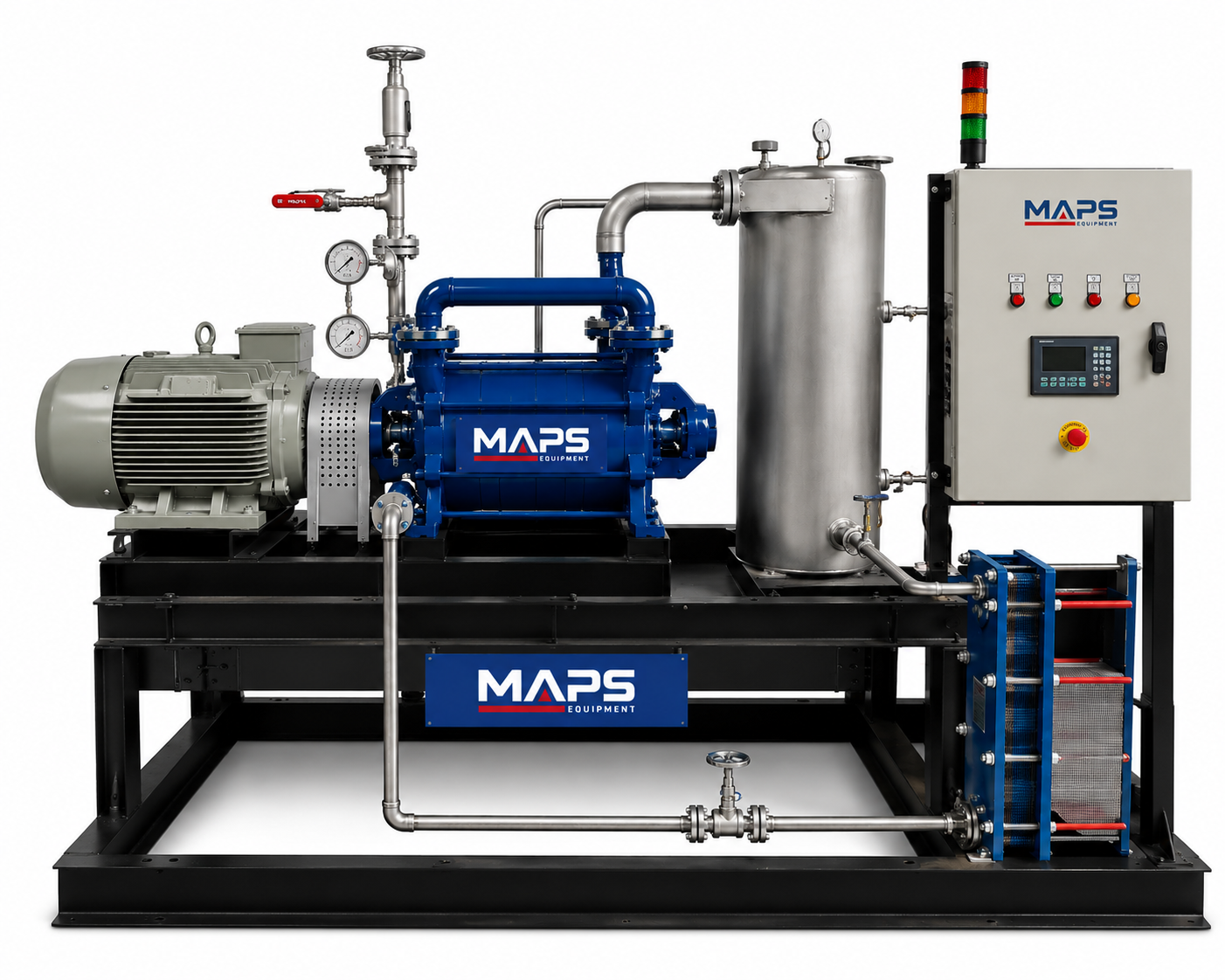
An advanced configuration where the sealing liquid is recirculated within a closed loop rather than continuously supplied and discharged. Reduces water consumption dramatically and allows use of specialised process-compatible liquids.
Advantages
- ✔Minimal water/liquid consumption
- ✔Compatible with specialised liquids (glycol, oil)
- ✔Eco-friendly — low effluent discharge
- ✔Handles contaminated or hazardous gases
- ✔Stable, continuous operation
Limitations
- ✖Higher initial cost than open-loop
- ✖More complex — needs recirculation pump, separator, and cooling
- ✖Limited vacuum depth vs dry pumps
Closed-Loop Working Principle
- 1
Rotor and Casing — Same eccentric rotor design as conventional liquid ring; liquid forms a rotating ring under centrifugal force.
- 2
Gas Suction — Gas enters through the inlet port and is trapped in variable-volume cavities between vanes and liquid ring.
- 3
Compression & Discharge — Cavities shrink as rotor turns, compressing gas. The gas-liquid mixture exits through the discharge port.
- 4
Liquid Separation — An internal or external cyclone separator removes liquid from the discharged gas stream.
- 5
Cooling — Separated liquid passes through a heat exchanger to remove absorbed heat before recirculation.
- 6
Recirculation — Cooled liquid is pumped back into the pump casing, completing the closed loop with minimal loss.
| Feature | Closed-Loop | Open-Loop |
|---|---|---|
| Liquid Consumption | Minimal | Continuous supply needed |
| Wastewater Output | Very low | High |
| Specialised Liquids | Yes | Limited |
| Operating Cost | Lower long-term | Higher |
| System Complexity | Higher | Simple |
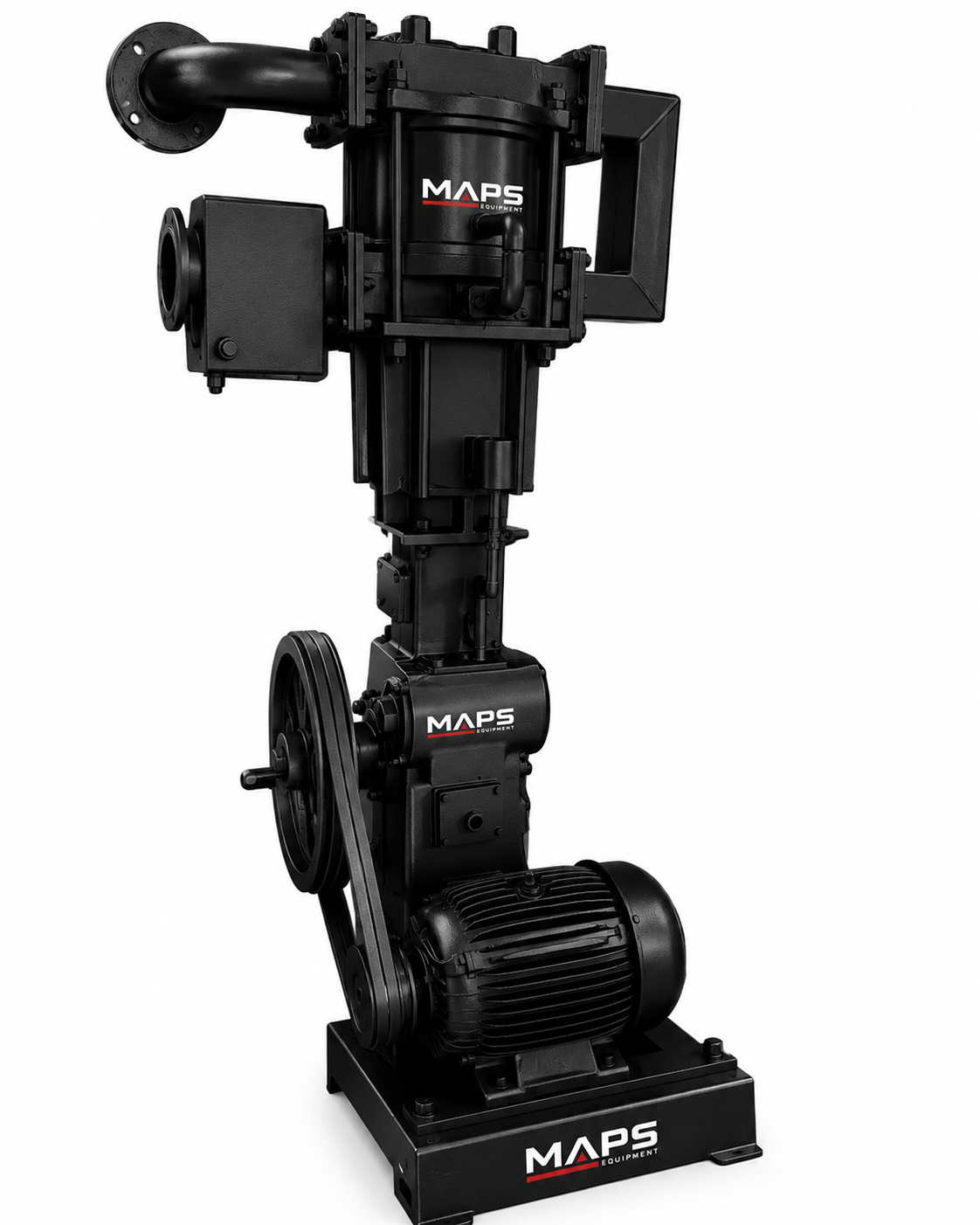
Dry Piston Vacuum Pump
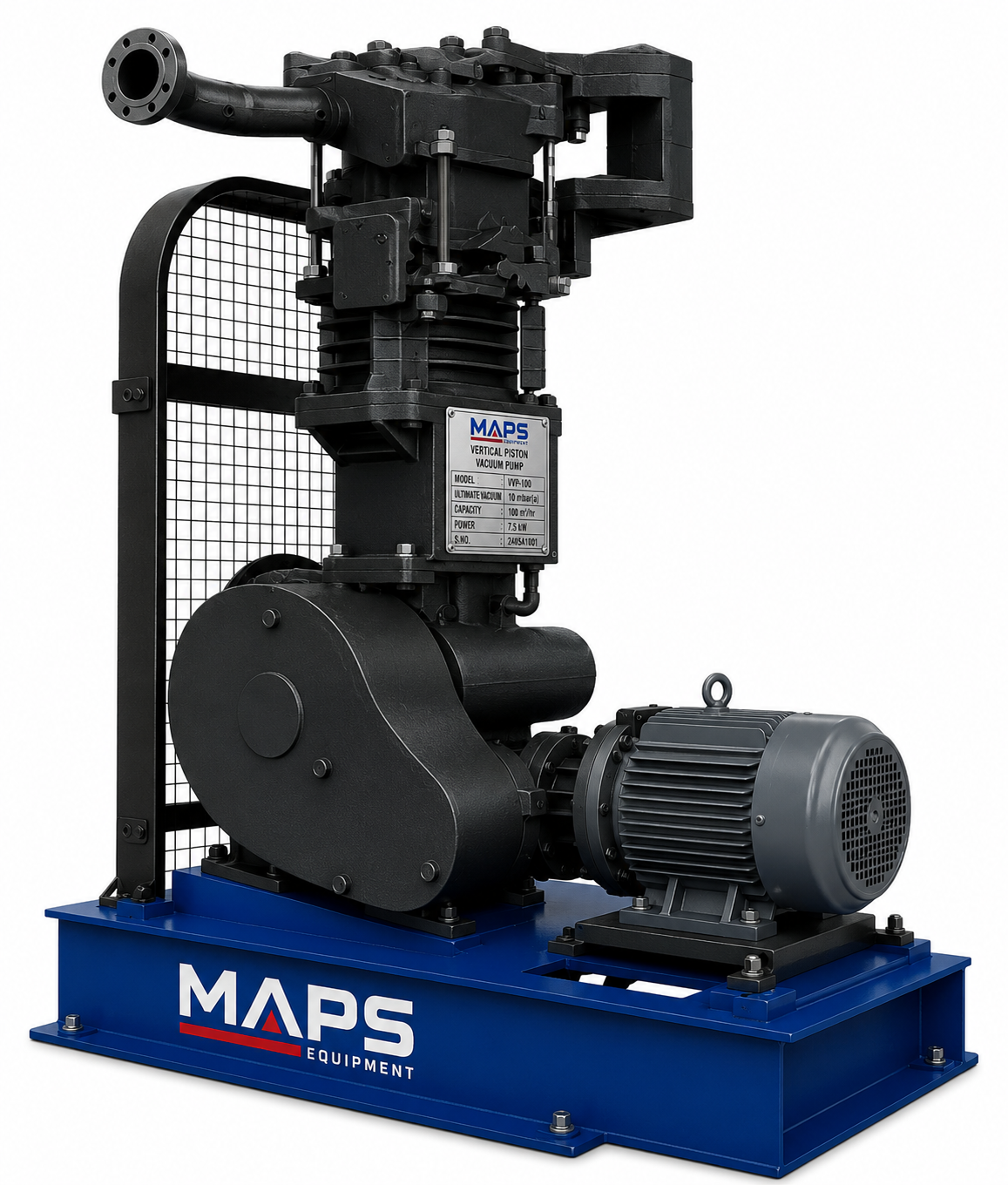
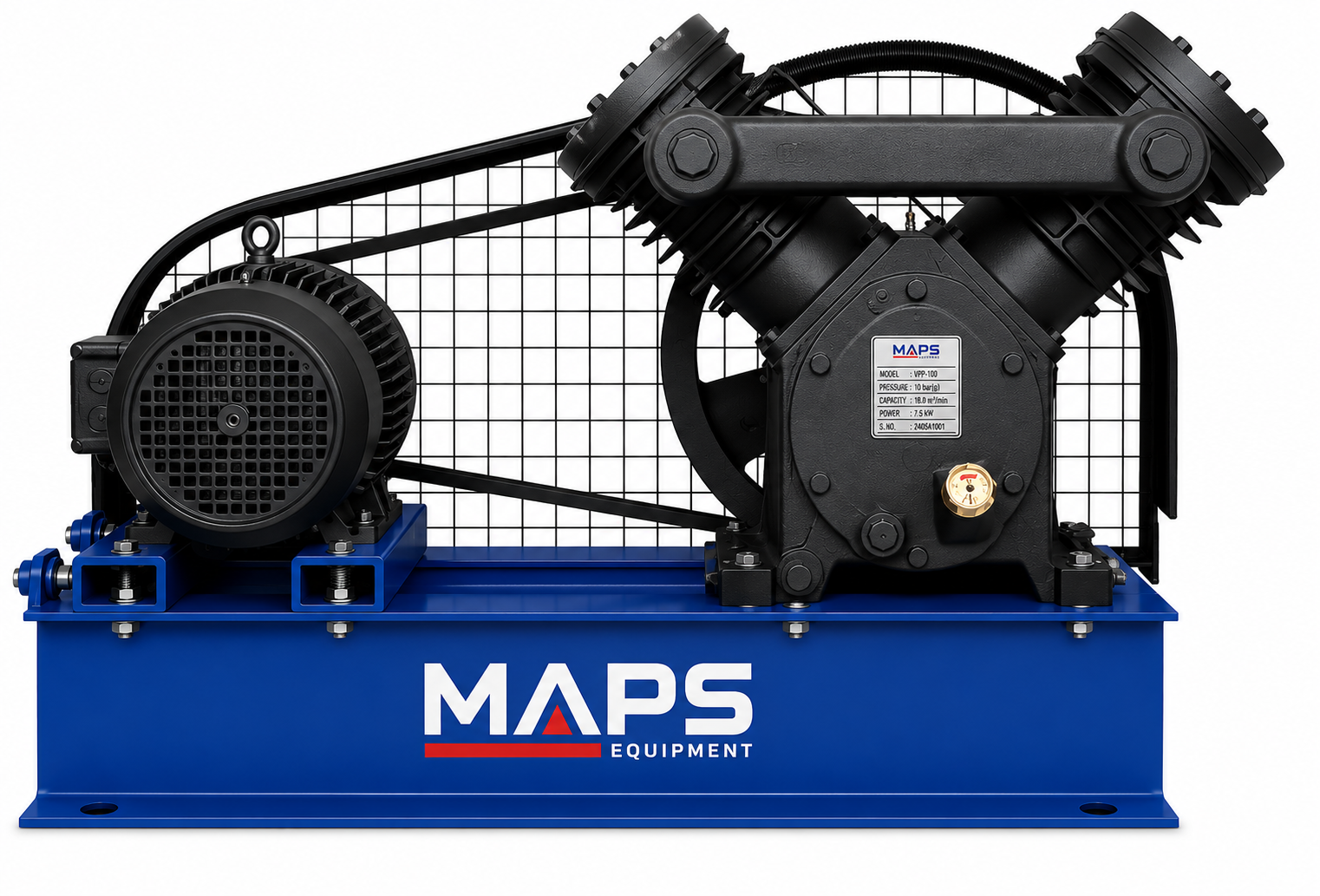
Uses a reciprocating piston to create vacuum without any oil or liquid in the compression chamber. Called "dry" because the piston uses self-lubricating PTFE-based rings — no oil contamination is possible.
Advantages
- ✔Oil-free — no contamination risk
- ✔Low maintenance requirements
- ✔Simple, compact construction
- ✔Clean exhaust air
- ✔Suitable for lab and medical use
Limitations
- ✖Limited ultimate vacuum (~100–150 mbar)
- ✖Not suitable for large industrial systems
- ✖Piston rings wear over time
- ✖Can be noisier than rotary pumps
Performance Range
Working Principle
- 1
The piston moves downward (suction stroke), increasing cylinder volume and drawing gas in through the inlet valve.
- 2
The inlet valve closes as the piston reverses direction; gas is now sealed inside the cylinder.
- 3
The piston moves upward (compression stroke), reducing volume and compressing the trapped gas.
- 4
When pressure is sufficient, the discharge valve opens and compressed gas exits to atmosphere.
- 5
The cycle repeats continuously via a crank-and-connecting-rod mechanism driven by the motor.
Applications
Suction Equipment
Operating theatre suction, wound care, and medical aspiration systems.
Vacuum Filtration
Benchtop filtration, rotary evaporator support, and analytical instruments.
Dental Systems
Chair-side suction and saliva ejector vacuum in dental surgeries.
Small-Scale Packaging
Vacuum packaging at laboratory and small production scale.
Oil Ring Vacuum Pump
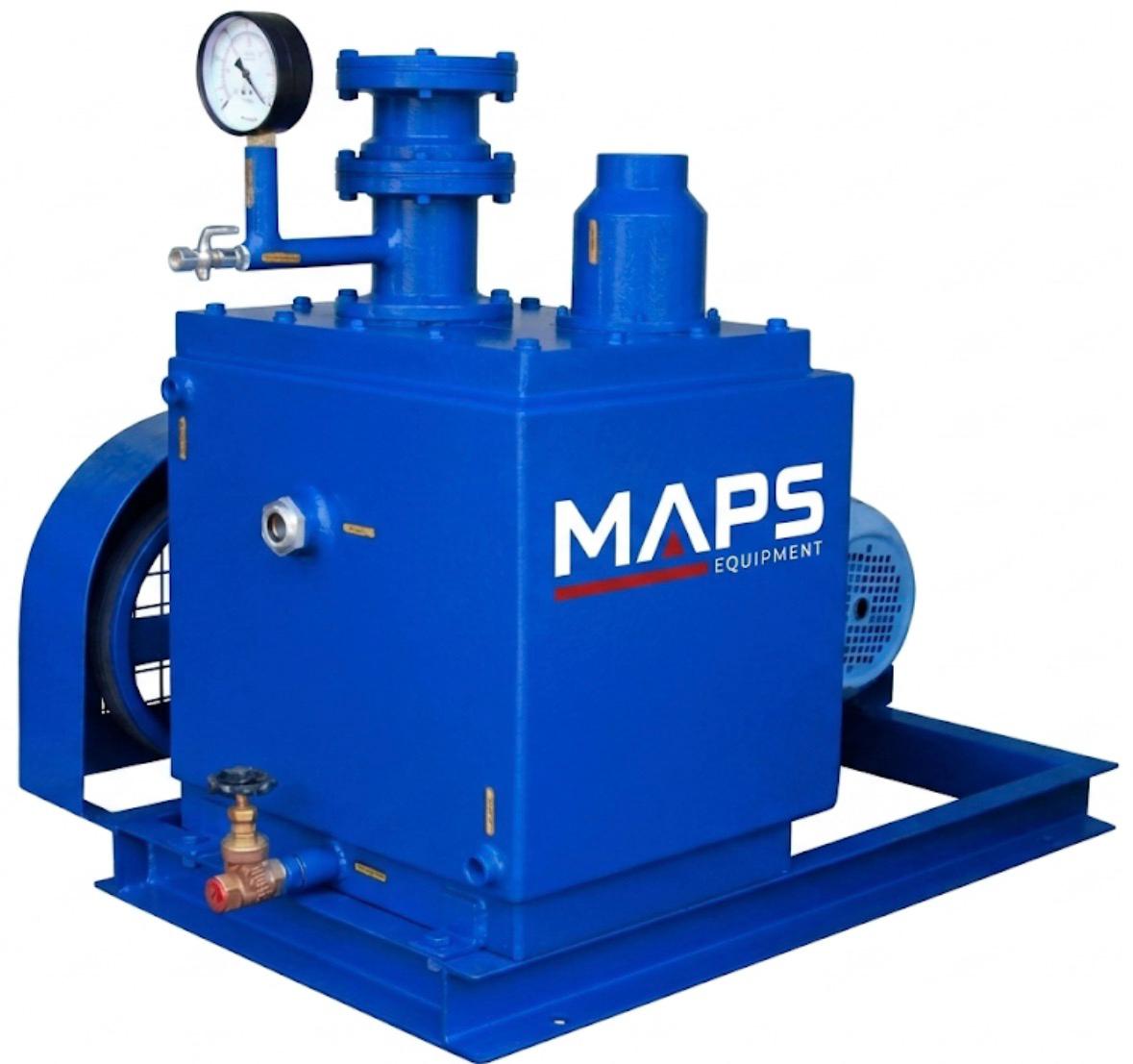
A variant of the liquid ring pump where oil replaces water as the sealing and compression medium. Oil provides better lubrication, lower corrosion risk, and slightly deeper vacuum capability — ideal for dry gas processes where water contact must be avoided.
Advantages
- ✔Excellent sealing properties
- ✔Low corrosion risk vs water ring
- ✔Better for dry gas applications
- ✔Stable vacuum level
- ✔No scaling or mineral deposits
Limitations
- ✖Oil contamination if gas contains impurities
- ✖Periodic oil replacement required
- ✖Not ideal for highly condensable vapours
- ✖Higher operating cost than water ring
Performance
Working Principle
- 1
Pump casing is partially filled with oil. The rotor is eccentrically mounted inside the casing.
- 2
Centrifugal force causes oil to form a rotating ring along the inner casing wall as the rotor spins.
- 3
Gas enters the suction port and is trapped between rotor blades and the oil ring in variable-volume cavities.
- 4
As the rotor continues, cavity volume decreases and gas compresses against the oil ring.
- 5
Compressed gas discharges through the outlet port. Oil is separated and recirculated internally.
| Feature | Oil Ring | Water Ring |
|---|---|---|
| Sealing Medium | Oil | Water |
| Corrosion Risk | Low | Moderate |
| Maintenance | Oil change needed | Water management |
| Vacuum Level | Slightly deeper | Moderate |
| Wet Gas Handling | Limited | Excellent |
Rotary Vane Vacuum Pump
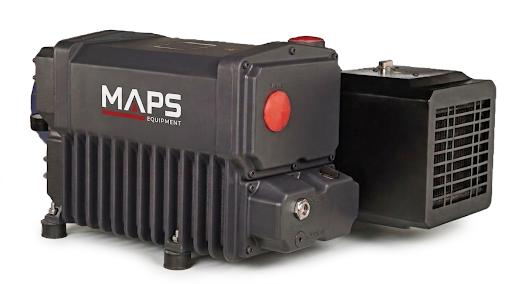
One of the most widely used vacuum pump types. Uses sliding vanes in an eccentric rotor to continuously trap and compress gas — available in oil-sealed (deeper vacuum) and dry (oil-free) configurations.
Advantages
- ✔Simple, reliable design
- ✔Excellent ultimate vacuum (oil-sealed)
- ✔Compact and economical
- ✔Widely available, easy to service
- ✔Smooth, steady vacuum output
Limitations
- ✖Oil contamination risk (oil-sealed type)
- ✖Requires regular oil changes
- ✖Sensitive to moisture (oil type)
- ✖Vanes wear over time
Two Variants
Working Principle
- 1
A rotor is mounted eccentrically inside a cylindrical housing. Sliding vanes are fitted in rotor slots.
- 2
As the rotor turns, centrifugal force pushes the vanes outward against the housing wall, maintaining a constant seal.
- 3
Gas enters through the inlet port and is trapped between two adjacent vanes and the housing wall.
- 4
Continued rotation reduces the trapped cavity volume, compressing the gas progressively.
- 5
Compressed gas exits through the discharge valve. Oil (in oil-sealed type) lubricates, seals, and cools throughout.
Applications
Vacuum Packaging
Food, pharmaceutical, and industrial product vacuum sealing.
Refrigeration Servicing
Evacuating refrigerant circuits before charging with new refrigerant.
Vacuum Forming
Thermoforming and plastic sheet moulding processes.
Laboratory Systems
Rotary evaporators, filtration, and general laboratory vacuum.
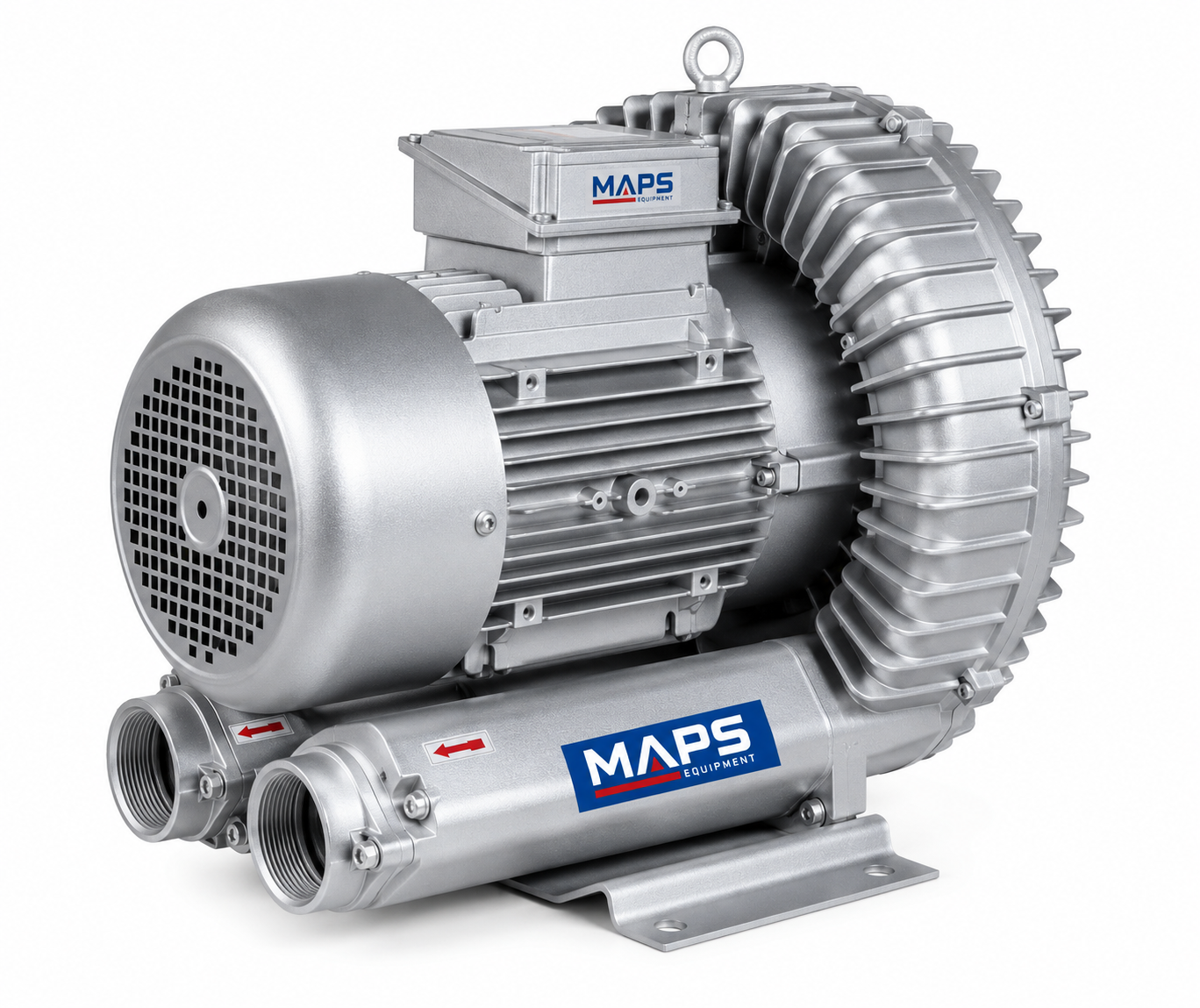
Side Channel Blower
Also called a Regenerative Blower or Ring Blower. Uses an impeller with multiple small blades that accelerate air repeatedly around a side channel — generating continuous, oil-free, pulsation-free airflow at low to moderate pressure or vacuum.
Advantages
- ✔Completely oil-free operation
- ✔Very low maintenance
- ✔Pulsation-free, smooth airflow
- ✔Compact and lightweight
- ✔Quiet compared to other blowers
Limitations
- ✖Limited pressure capability (max ~0.7 bar)
- ✖Not suitable for high or deep vacuum
- ✖Sensitive to dust — requires inlet filter
- ✖Lower efficiency than Roots blower at high pressure
Operating Range
Working Principle
- 1
The impeller with multiple small blades rotates at high speed inside a circular side-channel housing.
- 2
Air is drawn into the side channel at the inlet, where it is accelerated outward by the rotating blades.
- 3
Air follows a helical path through the side channel — re-entering the impeller blades repeatedly during each rotation.
- 4
Each re-entry adds more energy to the air — this repeated acceleration is the "regenerative" effect.
- 5
Air exits at the outlet with increased pressure or reduced pressure (vacuum) depending on connection mode.
Applications
Tank Aeration
Continuous aeration of biological wastewater treatment basins.
Pneumatic Transfer
Low-pressure pneumatic conveying of powders and granules.
Sheet Feeding
Vacuum sheet separation and feeding in printing machines.
Fish Farm Aeration
Oxygen supply to fish farm tanks and aquaculture systems.
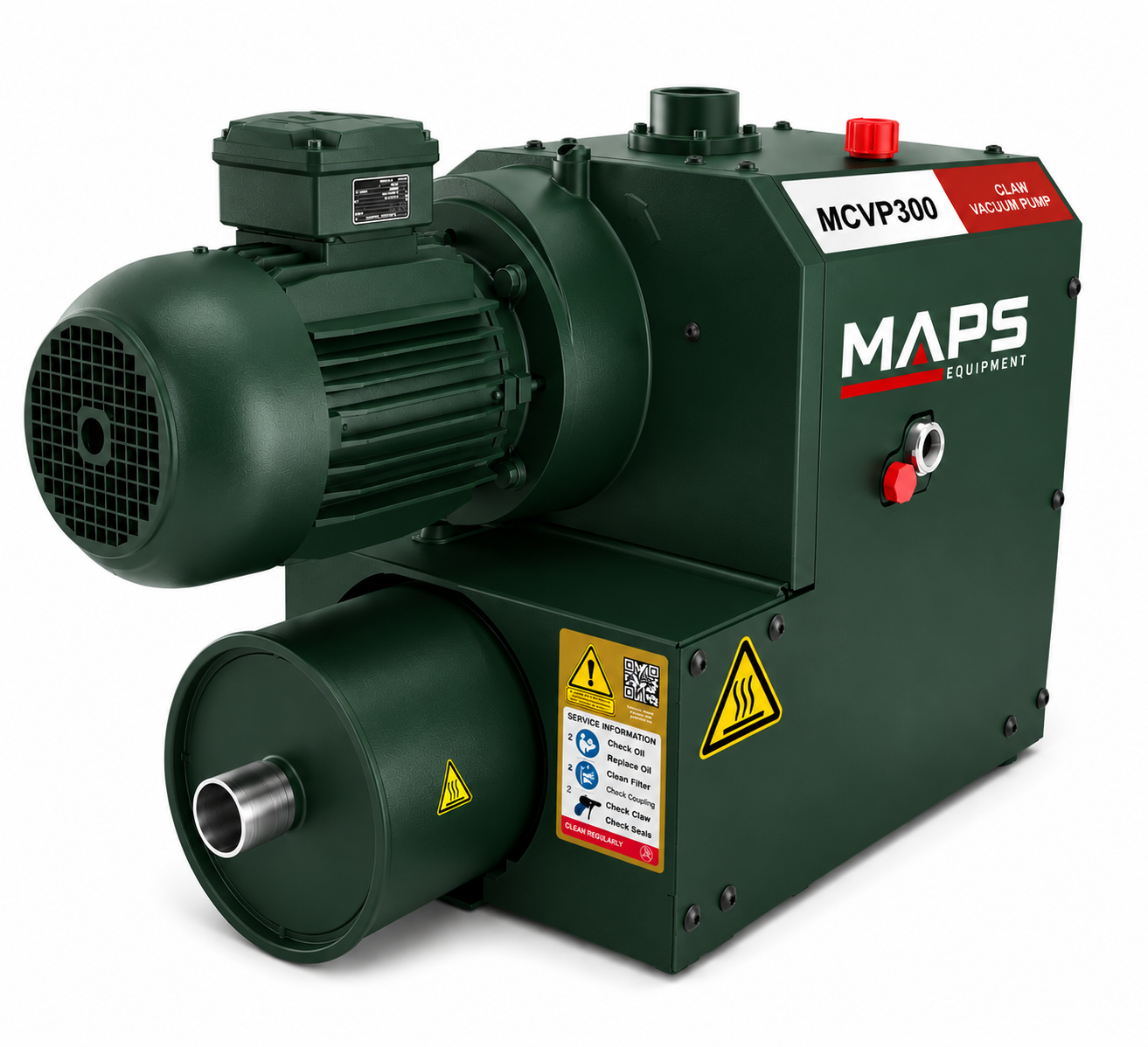
Single Stage Claw Pump
A dry positive displacement vacuum pump using two claw-shaped rotors that rotate in opposite directions without touching each other or the casing. Delivers oil-free, clean vacuum with high efficiency and long service life.
Advantages
- ✔Completely oil-free compression
- ✔Low maintenance — no vanes to replace
- ✔High energy efficiency
- ✔Long service life
- ✔Handles slightly contaminated gases
Limitations
- ✖Higher initial purchase cost
- ✖Ultimate vacuum limited vs oil-sealed rotary vane
- ✖Sensitive to heavy dust without pre-filtration
Performance
Working Principle
- 1
Two claw-shaped rotors rotate in opposite directions inside the pump housing, driven by synchronised external gears.
- 2
Gas enters through the inlet port as the claws create an expanding cavity on the suction side.
- 3
The rotating claws trap the gas and carry it forward from inlet to outlet side of the housing.
- 4
The trapped cavity reduces in volume as the claws continue rotating — compressing the gas internally.
- 5
Compressed gas discharges through the outlet port. No oil is used anywhere in the gas path.
| Feature | Claw Pump | Oil-Sealed Rotary Vane |
|---|---|---|
| Oil in Chamber | No | Yes |
| Maintenance | Low | Moderate |
| Vacuum Level | Medium (~100 mbar) | High (~1–5 mbar) |
| Energy Efficiency | High | Moderate |
| Clean Operation | Excellent | Risk of oil carryover |
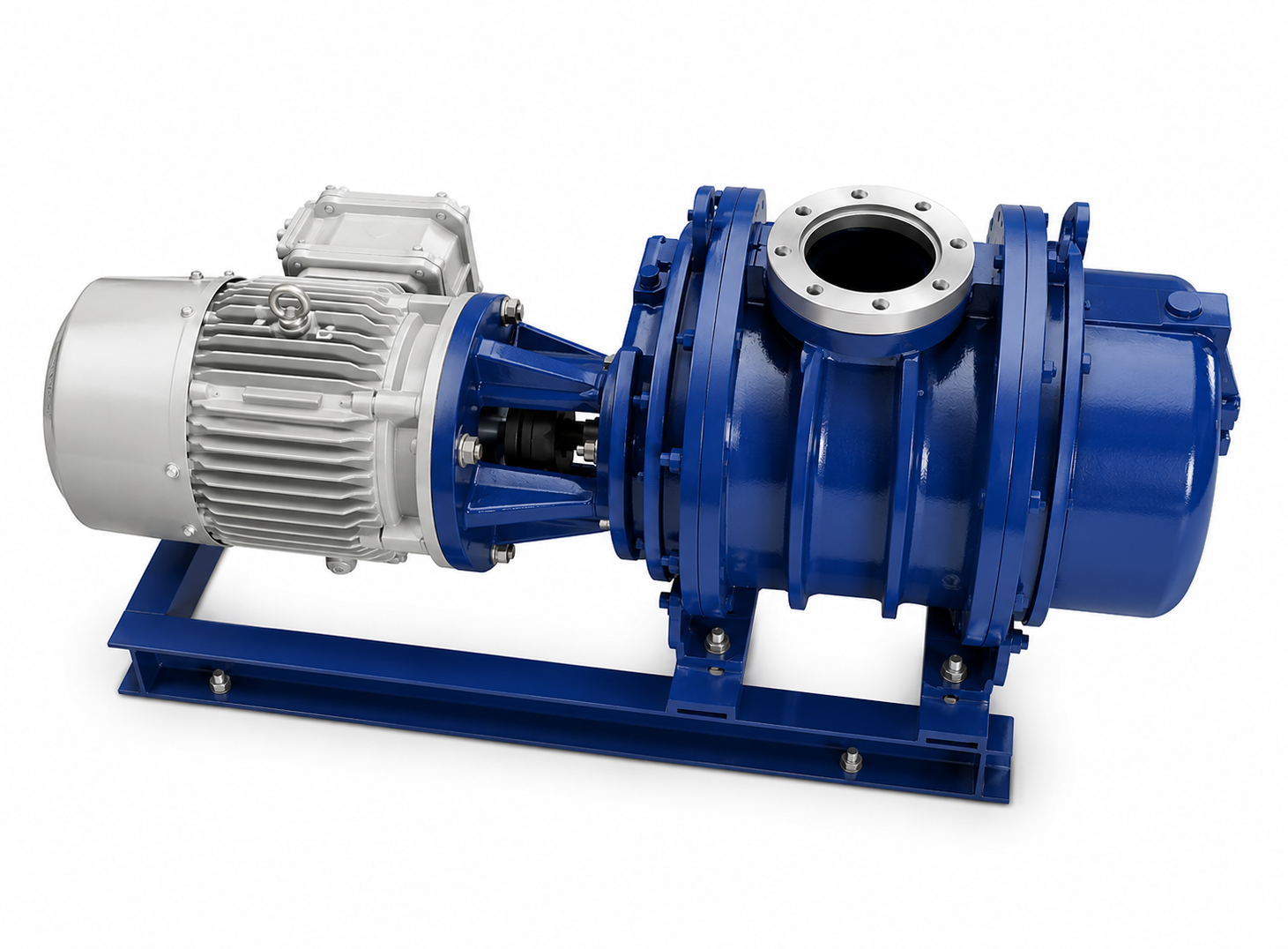
Mechanical Vacuum Booster (Roots Booster)
A Mechanical Vacuum Booster (MVB), also known as a Roots Vacuum Booster, is a high-performance pump that increases pumping speed and improves ultimate vacuum of an existing system. It runs in combination with a backing pump — it does not discharge directly to atmosphere; it compresses process gas and hands it off to the backing pump.
Advantages
- ✔Increases pumping speed by up to 5–10×
- ✔Oil-free pumping chamber, no contamination
- ✔Non-contact rotors — low wear, low maintenance
- ✔Reduces evacuation time, raises productivity
- ✔Suitable for continuous 24×7 operation
Considerations
- ✖Cannot discharge directly to atmosphere
- ✖Always needs a compatible backing pump
- ✖Differential pressure limit per stage
Technical Specifications
Working Principle
- 1
Two lobed Roots rotors rotate in opposite directions, synchronised by external timing gears.
- 2
Gas is drawn in at the inlet and trapped between a rotor lobe and the casing wall as the rotors turn.
- 3
The trapped gas is carried around the casing from inlet side to outlet side without internal compression.
- 4
At the outlet, the gas is back-compressed by gas already at discharge pressure — a process unique to Roots-type pumps.
- 5
Compressed gas is transferred to the backing pump, which compresses it further to atmospheric pressure.
- 6
Because there's no internal contact, the booster runs without lubrication in the chamber, ensuring clean operation.
Compatible Backing Pumps
Construction Materials (MOC)
Pump Body
Cast Iron (CI), SS304, SS316, SS316L
Rotors
Cast Iron, SG Iron, Stainless Steel
Shaft
Alloy Steel, SS410, SS304
Mechanical Seals
Carbon/Ceramic, Silicon Carbide, Tungsten Carbide
O-Rings
NBR, Viton (FKM), EPDM, PTFE
Coating Options
Epoxy, PTFE, Nickel Plating (corrosive gases)
Key Features
High Pumping Speed
Strong performance across medium and high vacuum range.
Faster Evacuation
Significantly reduces overall system evacuation time.
Non-Contact Rotors
Wear-free design with no internal lubrication needed.
Oil-Free Chamber
Clean operation suitable for sensitive processes.
Low Vibration
Quiet, smooth running even at high speeds.
VFD Compatible
Can integrate with VFD for energy-efficient operation.
Cooling Options
Available in air-cooled or water-cooled configurations.
Continuous Duty
Rugged construction built for 24×7 industrial use.
Applications
Vacuum Drying & Distillation
Faster, more efficient evacuation for drying and distillation processes.
Pharmaceutical Manufacturing
Clean, oil-free boosting for pharma vacuum systems.
Food Processing & Packaging
Improves cycle times in food vacuum packaging lines.
Vacuum Furnaces & Heat Treatment
High-speed evacuation for furnace and heat-treatment chambers.
Vacuum Coating Systems
Used in PVD/CVD and other vacuum coating processes.
Transformer Drying
Rapid moisture removal during transformer manufacturing.
Extrusion & Degassing
Degassing support in plastic extrusion processes.
Semiconductor Industry
Clean, high-speed boosting for semiconductor vacuum systems.
Industries Served
Interested in Vaccum?
Contact our team for specifications, pricing, and availability.
Understanding Vacuum
A vacuum is any space where pressure is lower than atmospheric pressure — where gas molecules are significantly reduced compared to normal air. It is a foundational principle behind dozens of industrial, scientific, and medical processes.
Understanding Vacuum
Vacuum is measured relative to atmospheric pressure. Standard atmosphere at sea level is ~101.3 kPa (1 atm). Any pressure below this is considered vacuum — ranging from rough industrial vacuum all the way to near-perfect conditions in scientific research.
Atmospheric Pressure at Sea Level — the baseline from which all vacuum levels are measured (1 atm = 760 mmHg = 1013 mbar)
Absolute (Perfect) Vacuum — theoretically zero pressure with no gas molecules. Practically impossible to achieve; all real systems approach this asymptotically.
Vacuum Measurement Units
Vacuum can be expressed in multiple units depending on industry and region. All represent the same phenomenon — pressure below atmospheric.
| Unit | Atmospheric Reference | Common Use |
|---|---|---|
| mmHg | 760 mmHg = atmospheric pressure | Medical, laboratory |
| Torr | 760 Torr = atmospheric pressure (1 Torr ≈ 1 mmHg) | Scientific instruments |
| mbar | 1013 mbar = atmospheric pressure | Industrial vacuum |
| Pa (Pascal) | 101,325 Pa = atmospheric pressure | SI standard |
| Inches of Hg | 29.92 inHg = atmospheric pressure | HVAC, US industry |
Types of Vacuum
Vacuum is categorised into four levels based on the absolute pressure range, each suited to specific applications and requiring different pump technologies.
Low Vacuum
Ventilation systems, vacuum packaging, rough material handling, simple suction applications.
Medium Vacuum
Vacuum drying, degassing, chemical distillation, evaporation and food processing.
High Vacuum
Laboratory processes, electron microscopy, thin-film deposition, surface analysis equipment.
Ultra High Vacuum
Semiconductor fabrication, particle accelerators, space simulation chambers, quantum research.
Methods of Creating Vacuum
Different pump technologies are used depending on the required vacuum depth, gas type, and flow rate.
Mechanical Pumps
- Rotary vane pump — low to medium vacuum
- Dry piston pump — low vacuum, oil-free
- Claw pumps — clean, dry medium vacuum
Liquid Ring Pumps
- Water or oil as compression liquid
- Handles wet, humid, or condensable gases
- Open-loop or closed-loop systems
Roots / Booster Pumps
- Medium vacuum with higher flow rates
- Used in combination with backing pumps
- Industrial and chemical processes
High Vacuum Pumps
- Diffusion pumps — high vacuum
- Turbomolecular pumps — ultra-high vacuum
- Used in scientific and semiconductor applications
Side Channel Blowers
- Low-pressure vacuum and compressed air
- Continuous, pulsation-free airflow
- Oil-free, low maintenance design
Vacuum Applications
Vacuum technology serves a vast range of industries — from food production to particle physics. Here are the key application areas.
Forming & Packaging
Vacuum forming of plastic sheets, automated vacuum packaging, and degassing of resins and composites.
Surgical Suction
Vacuum suction in operating theatres, wound care systems, and medical aspiration equipment.
Electron Microscopy
High and ultra-high vacuum environments for electron beams, particle accelerators, and surface analysis.
Freeze Drying
Freeze-drying and vacuum sealing to preserve food quality, aroma, and extend shelf life.
Semiconductor Manufacturing
PVD coating, CVD deposition, and clean-room semiconductor fabrication processes.
Distillation & Drying
Vacuum distillation of temperature-sensitive compounds, and drying of solvents and pharmaceuticals.
Advantages & Disadvantages of Using Vacuum
✔ Advantages
- ✔Prevents oxidation and contamination of products and processes
- ✔Enables low-pressure processing of temperature-sensitive materials
- ✔Reduces the boiling point of liquids — essential for drying and distillation
- ✔Highly efficient for material handling, lifting, and packaging
- ✔Creates controlled environments for scientific and electronics research
✖ Considerations
- ✖Vacuum systems require sealed vessels and careful leak management
- ✖Deeper vacuum levels require more specialised and expensive equipment
- ✖Energy consumption increases significantly at high vacuum levels
- ✖Regular maintenance of pumps, seals, and filters is essential
Key Vacuum Terms
Understanding these fundamental terms is essential for specifying vacuum systems and communicating with equipment suppliers.
Absolute Pressure
Pressure measured relative to a perfect vacuum (0 kPa). Used in vacuum engineering to describe the true pressure level in a system.
Gauge Pressure
Pressure measured relative to atmospheric pressure. Vacuum is expressed as negative gauge pressure (e.g. –0.8 bar gauge).
Partial Vacuum
Any pressure below atmospheric but above absolute zero. The vast majority of industrial vacuum applications operate in this range.
Ultimate Vacuum
The lowest pressure a given pump can achieve under ideal conditions with no gas load. A key specification when selecting vacuum equipment.
Pumping Speed
The volumetric flow rate at which a pump removes gas from a vessel, expressed in m³/h, L/s, or CFM.
Absolute Vacuum
0 kPa — theoretically complete absence of matter. Practically impossible to achieve; only approached asymptotically in scientific applications.
Which Vacuum Pump Is Right for You?
The right vacuum pump depends on your required vacuum level, gas type, flow rate, and duty cycle. Use this quick guide to narrow down your options.
| Pump Type | Ultimate Vacuum | Gas Type | Oil-Free | Best Application |
|---|---|---|---|---|
| Liquid Ring (Water) | 33–50 mbar | Wet / contaminated | Yes | Chemical, food, paper |
| Liquid Ring (Closed-Loop) | 33–50 mbar | Wet / hazardous | Yes | Eco-sensitive sites, specialised liquids |
| Oil Ring | 10–50 mbar | Dry gas | No | Pharma, chemical, degassing |
| Rotary Vane (Oil-Sealed) | 0.1–5 mbar | Clean dry gas | No | Lab, HVAC, packaging |
| Dry Piston | 100–150 mbar | Clean dry gas | Yes | Medical, dental, lab |
| Single Stage Claw | 100–150 mbar | Clean / slightly contaminated | Yes | Packaging, printing, central vacuum |
| Side Channel Blower | –500 mbar vacuum | Clean air only | Yes | Aeration, conveying, printing |
| Mechanical Vacuum Booster | Up to 0.001 mbar (with backing pump) | Clean / process gas | Yes | High-speed evacuation, furnaces, coating, pharma |