

How a Nitrogen Generator Works
Atmospheric air is approximately 78% nitrogen and 21% oxygen. Nitrogen generators separate these gases on-site using one of two proven technologies — choose based on your purity and flow requirements.
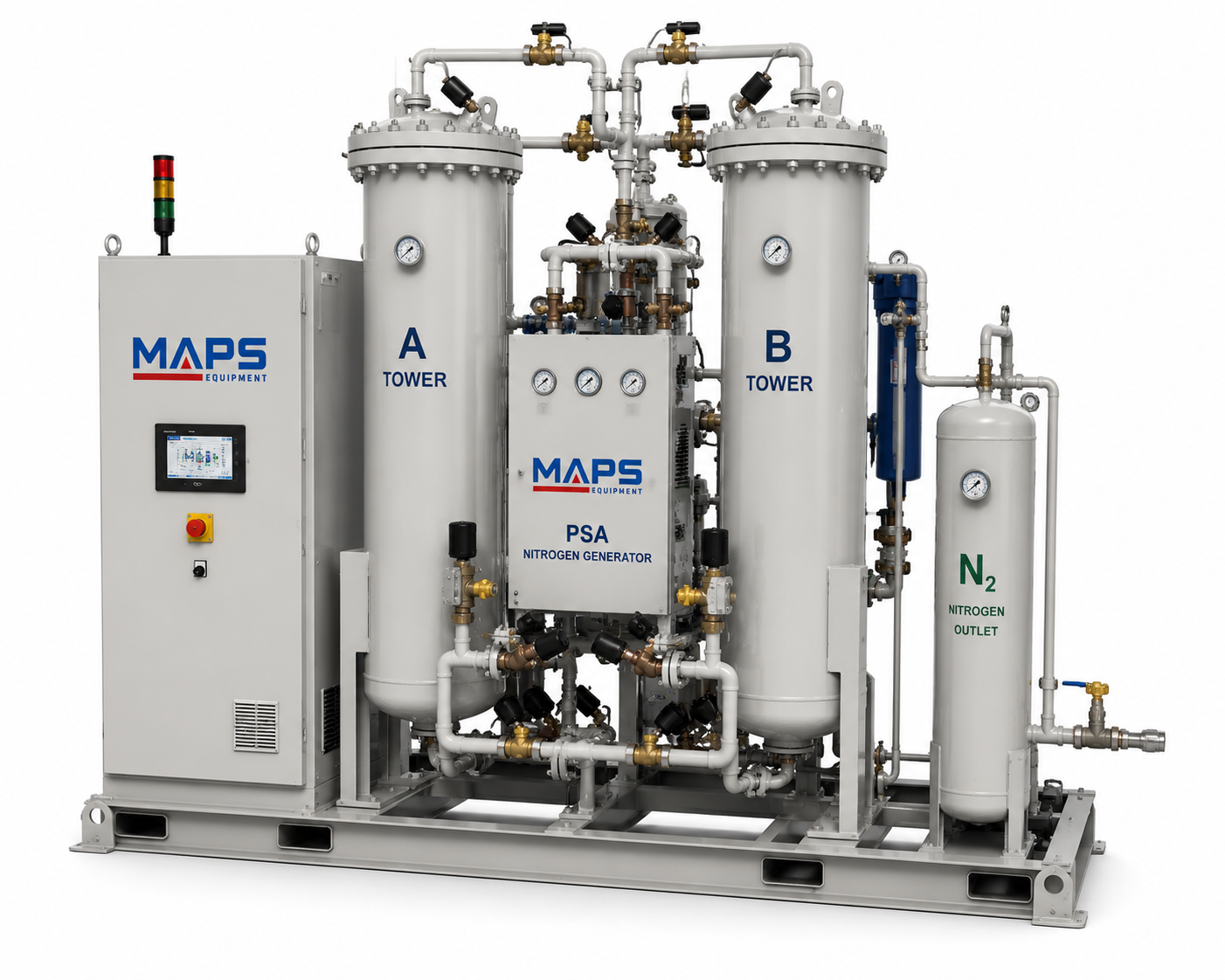
Pressure Swing Adsorption (PSA)
PSA uses a carbon molecular sieve (CMS) to selectively adsorb oxygen, CO₂, and moisture from compressed air — allowing high-purity nitrogen to pass through and be collected. Two alternating towers ensure continuous output.
Produces nitrogen purity of 95–99.999% — the highest available from an on-site generator.
Advantages
- ✔ High purity (up to 99.999%)
- ✔ On-site, continuous generation
- ✔ Eliminates cylinder/liquid N₂ dependency
- ✔ Cost-effective long-term
Limitations
- ✖ Requires high-quality compressed air
- ✖ 10–15% purge air loss for regeneration
- ✖ Regular molecular sieve maintenance
- ✖ Higher initial investment
Step-by-Step Process
-
1
Compressed Air Supply — Clean, dry, oil-free air from a compressor and air dryer is fed into the system.
-
2
Adsorption Tower — Air passes through a carbon molecular sieve (CMS) bed that adsorbs oxygen, CO₂, and moisture; nitrogen flows through.
-
3
Dual Tower Cycle — While Tower A produces nitrogen, Tower B regenerates by venting adsorbed oxygen at low pressure.
-
4
Nitrogen Collection — Purified nitrogen enters a buffer storage tank, stabilising flow and pressure for the application.
-
5
Automatic Switching — A PLC controller switches towers every 30–120 seconds to maintain continuous, uninterrupted output.
Operating Principle
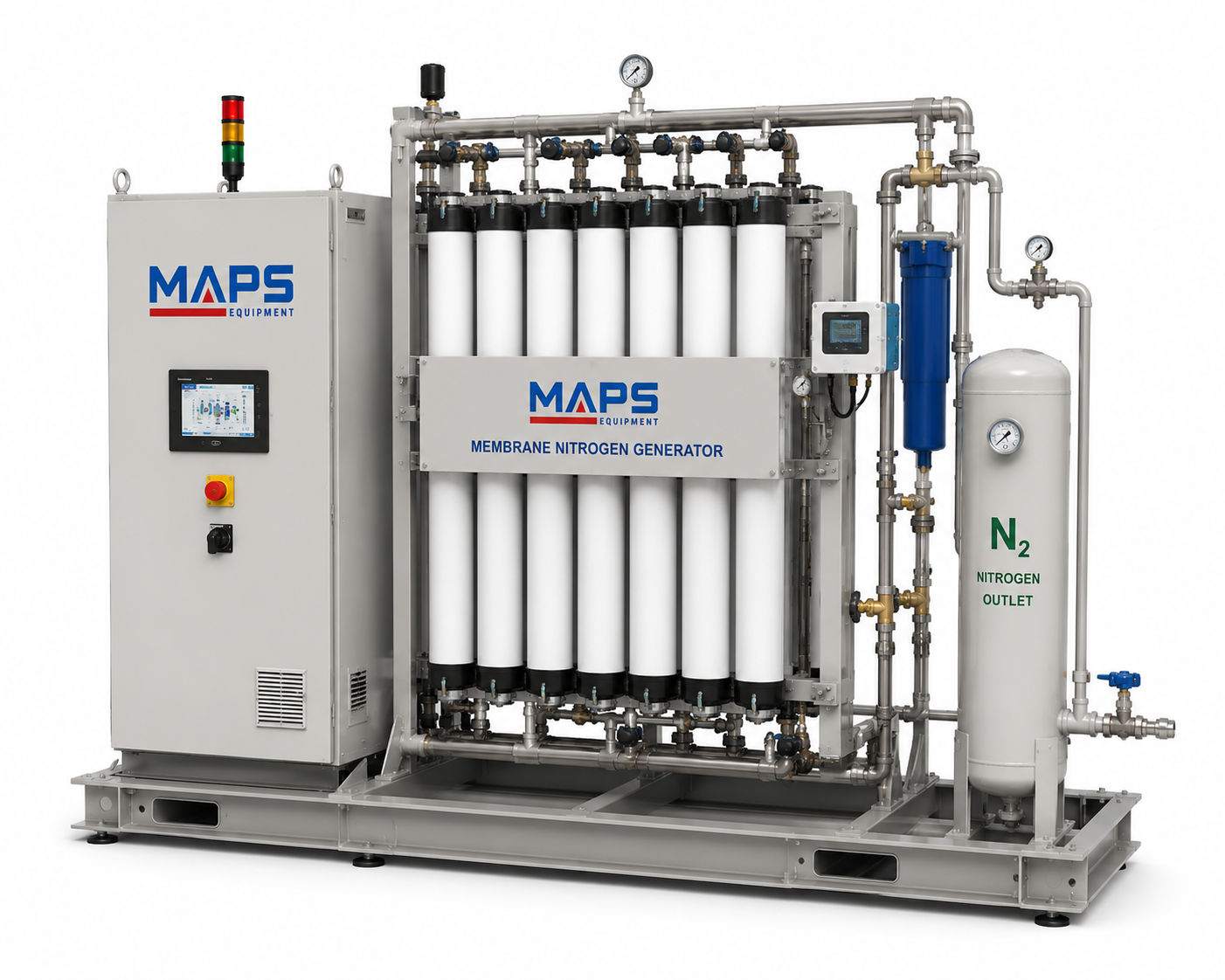
Membrane Nitrogen Generator
Membrane generators use special hollow-fibre polymer membranes that are selectively permeable — oxygen, CO₂, and water vapour permeate through the membrane walls while nitrogen is retained and flows out as product gas.
Delivers nitrogen purity of 95–99% in a compact, continuous-flow design with no moving parts inside the membrane module.
Advantages
- ✔ Compact and lightweight design
- ✔ No regeneration cycles required
- ✔ Low maintenance — no CMS to replace
- ✔ Instant start-up, continuous flow
Limitations
- ✖ Lower maximum purity than PSA (<99%)
- ✖ Sensitive to inlet air quality and pressure
- ✖ Higher air consumption at elevated purity
- ✖ Not suitable for ultra-high purity needs
Step-by-Step Process
-
1
Compressed Air Inlet — Pre-filtered, dried compressed air enters the membrane module under pressure.
-
2
Membrane Separation — Hollow-fibre polymer membranes allow oxygen, CO₂, and moisture to permeate through the walls and vent to atmosphere.
-
3
Nitrogen Retention — Nitrogen molecules, being larger, pass along the hollow fibres and exit as high-concentration product gas.
-
4
Purity Adjustment — Flow rate is controlled to balance purity against output volume; lower flow yields higher purity.
-
5
Delivery — Nitrogen flows continuously to storage or directly to the application point without interruption.
Key Characteristics
Interested in Nitrogen Generator?
Contact our team for specifications, pricing, and availability.
Nitrogen Generator
A Nitrogen Generator produces nitrogen gas (N₂) from compressed air on-site, providing a continuous, cost-effective, and high-purity supply — without relying on bottled or liquid nitrogen.
Key Components
Every nitrogen generator system — whether PSA or membrane — relies on the same core building blocks working in sequence.
Air Compressor
Provides clean, pressurised air (typically 5–10 bar) as the feed for the nitrogen generation process.
Air Dryer
Refrigerated or desiccant dryer removes moisture from compressed air, protecting downstream components.
Air Filters
Particulate and coalescing filters remove oil aerosols, dust, and contaminants before the separation stage.
PSA / Membrane Module
The core separation unit — either twin CMS adsorption towers (PSA) or hollow-fibre polymer membranes.
Nitrogen Storage Tank
Buffer tank stabilises output pressure and flow, decoupling production cycles from point-of-use demand.
Flow & Purity Sensors
Real-time monitoring of nitrogen purity (%), flow rate, and pressure ensures the system meets specification.
Nitrogen Purity Levels by Application
Different industries require different purity grades. Selecting the right purity level avoids over-engineering — and unnecessary cost.
| Application | Purity Required | Typical Generator Type |
|---|---|---|
| Food Packaging & Storage | 95–99% | Membrane or PSA |
| Electronics & Soldering | 99.9–99.999% | PSA |
| Oil & Gas Blanketing | 99% | PSA |
| Laser Cutting | 99.99% | PSA |
| Pharmaceutical Inerting | 99–99.9% | PSA |
| Laboratories & Research | 99.999% | PSA |
Advantages & Disadvantages
On-site nitrogen generation offers significant long-term benefits, though the upfront requirements must be considered carefully.
✔ Advantages
- ✔On-demand nitrogen production — available 24/7
- ✔Eliminates reliance on nitrogen cylinders or liquid N₂ deliveries
- ✔Significantly safer — no high-pressure cylinder handling
- ✔Cost-effective in the long term with predictable operating costs
- ✔Scalable — capacity can be expanded as demand grows
✖ Disadvantages
- ✖Higher initial capital investment vs. cylinder supply
- ✖Requires high-quality compressed air (dry, oil-free)
- ✖Regular maintenance of filters and molecular sieves (PSA)
- ✖Performance affected by inlet air temperature and quality
PSA vs Membrane — Quick Comparison
Use this guide to quickly identify which technology is right for your specific requirements.
Where Nitrogen Generators Are Used
From food packaging to precision manufacturing, on-site nitrogen generation serves a wide range of critical industrial processes.
Packaging & Storage
Modified atmosphere packaging, shelf-life extension, and storage tank blanketing to prevent oxidation.
Inerting & Blanketing
Purging reactors and storage vessels to maintain inert atmospheres and prevent contamination or explosion risk.
Soldering & Assembly
Wave soldering, reflow ovens, and laser cutting processes require high-purity nitrogen to prevent oxidation of components.
Pipeline & Tank
Pipeline purging, tank blanketing, and well stimulation operations to displace oxygen and prevent combustion risk.
Heat Treatment
Controlled atmosphere furnaces for annealing, sintering, and brazing operations in metal processing.
Analytical & Research
High-purity nitrogen as carrier gas for GC/MS instruments, sample preparation, and research environments.
Size Your Nitrogen Generator
To recommend the right PSA or membrane system for your application, we need just three parameters:
- Required nitrogen flow rate (Nm³/hr, L/min, or SCFM)
- Required purity level (%)
- Available compressed air pressure & quality (bar, dew point, oil content)
Once these are known, PSA tower sizing, molecular sieve volume, and buffer tank capacity can be calculated precisely for your needs.