

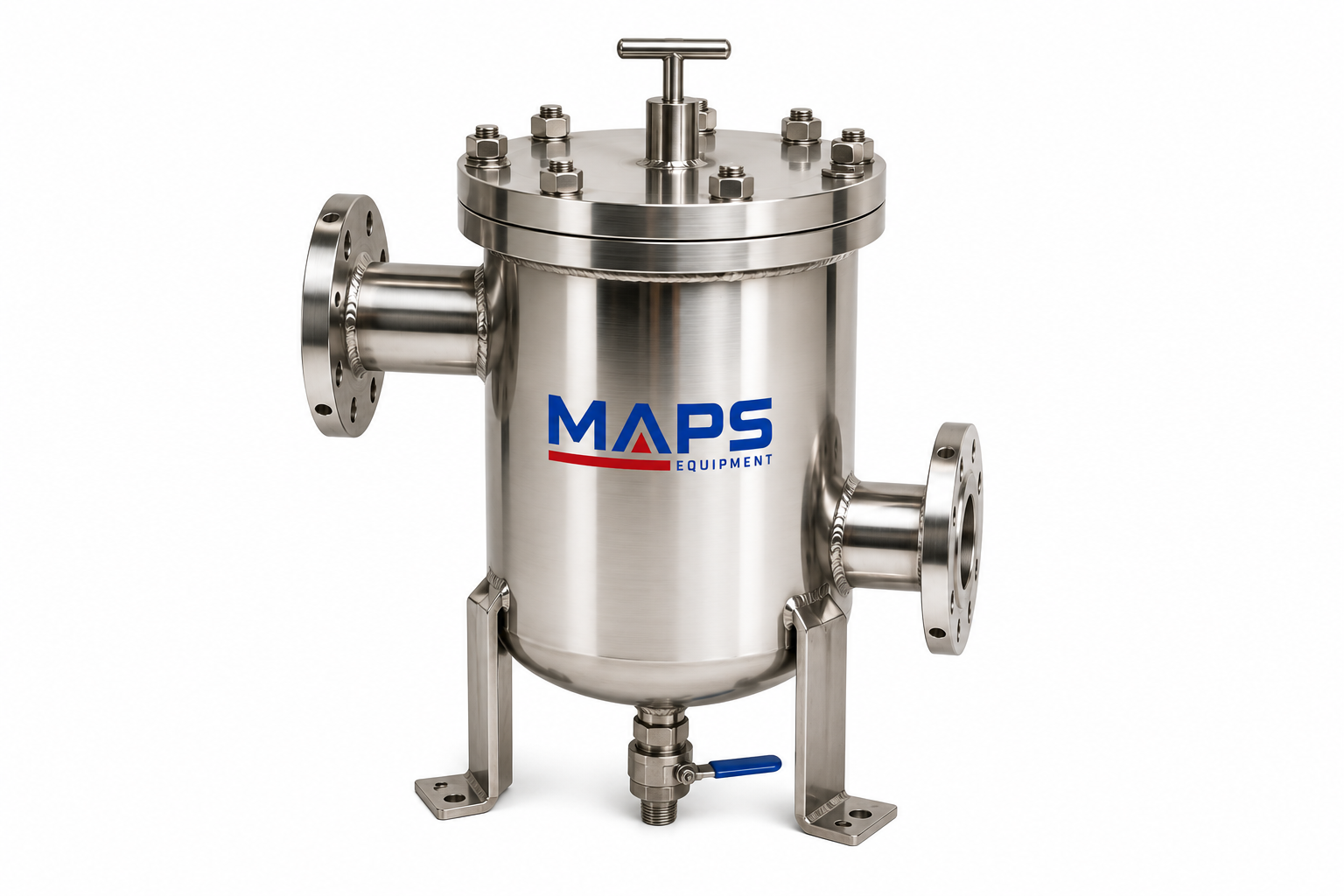
Catch Pot in Chemical Industries
A complete technical guide covering working principles, materials of construction, standard sizes, pressure ratings, applications, and design considerations for process engineers.
What is a Catch Pot?
Definition and function overview
A Catch Pot is a process vessel installed in pipelines to collect and separate liquid droplets, condensate, solids, dust particles, foam, or process carryover from gas or vapor streams before they reach downstream equipment such as vacuum pumps, compressors, blowers, ejectors, condensers, scrubbers, and instrumentation.
It acts as a protective barrier between the process and critical equipment, preventing damage caused by liquid ingress and contamination.
Working Principle
How gas-liquid separation occurs inside the vessel
Process gas/vapor enters the catch pot
Larger cross-sectional area reduces gas velocity
Heavier liquid droplets and particles separate due to gravity
Separated liquid collects at the bottom
Clean gas exits through the outlet nozzle
Liquid is drained manually or automatically
Separation Mechanisms
Typical Construction
Core components and optional accessories
Core Components
- Cylindrical shell
- Top head
- Bottom dish end / cone bottom
- Inlet nozzle
- Outlet nozzle
- Drain connection
- Vent connection
- Level gauge (optional)
- Sight glass (optional)
- Demister pad (optional)
- Support legs / skirt
Optional Accessories
- Pressure gauge
- Vacuum gauge
- Level switch
- Level transmitter
- Sample valve
- Flame arrester
- Rupture disc
- Safety valve
Materials of Construction (MOC)
Material selection depends on process conditions, corrosion resistance, temperature, and pressure
Carbon Steel (CS)
- IS 2062
- ASTM A36
- ASTM A516 Gr.70
- Economical
- Easy fabrication
- Non-corrosive applications
- Air systems
- Utility services
- General industrial vacuum
Stainless Steel 304
- Good corrosion resistance
- Hygienic surface finish
- Food industry
- Pharmaceutical industry
- Chemical processing
Stainless Steel 316 / 316L
- Excellent chemical resistance
- Resistant to chlorides & solvents
- Chemical plants
- Solvent recovery systems
- Pharmaceutical plants
- API manufacturing
Duplex Stainless Steel
- High strength
- Excellent chloride resistance
- Offshore plants
- Aggressive chemical services
Hastelloy C276
- Excellent resistance to strong acids
- Sulfuric acid systems
- HCl service
- Corrosive chemical processes
FRP (Fiber Reinforced Plastic)
- Lightweight
- Corrosion resistant
- Acid fumes
- Scrubber systems
- Chemical exhaust systems
Glass-Lined Steel
- Highly corrosion resistant
- Suitable for ultra-pure applications
- Specialty chemicals
- Pharmaceutical reactors
Standard Sizes
Laboratory, pilot plant, and industrial system capacities
Small Laboratory Systems
| Capacity | Diameter | Height |
|---|---|---|
| 5 L | 100 mm | 300 mm |
| 10 L | 150 mm | 400 mm |
| 20 L | 200 mm | 500 mm |
| 50 L | 250 mm | 800 mm |
Pilot Plants
| Capacity | Diameter | Height |
|---|---|---|
| 50 L | 250 mm | 800 mm |
| 100 L | 300 mm | 1000 mm |
| 200 L | 400 mm | 1200 mm |
| 500 L | 600 mm | 1500 mm |
Industrial Systems
| Capacity | Diameter | Height |
|---|---|---|
| 500 L | 600 mm | 1500 mm |
| 1000 L | 800 mm | 1800 mm |
| 2000 L | 1000 mm | 2500 mm |
| 5000 L | 1400 mm | 3500 mm |
Typical Nozzle Sizes
| Process Line | Catch Pot Nozzle |
|---|---|
| 1″ | 1″ – 1.5″ |
| 2″ | 2″ – 3″ |
| 4″ | 4″ – 6″ |
| 6″ | 6″ – 8″ |
| 8″ | 8″ – 10″ |
Pressure & Vacuum Design
Operating ranges and applicable design codes
Vacuum Service
- Full Vacuum (−760 mmHg)
- Vacuum up to 0.001 mbar systems
Pressure Service
- 0.5 kg/cm²
- 3 kg/cm²
- 10 kg/cm²
- 25 kg/cm²
- Higher on request
Design Codes
Applications in Chemical Industries
Where catch pots are installed across process systems
Vacuum Distillation Systems
Installed between distillation column, condenser, and vacuum pump. Prevents solvent carryover and protects the vacuum pump.
Reactor Vacuum Systems
Between reactor, condenser, vacuum booster and pump. Collects reaction condensate and prevents contamination.
Solvent Recovery Plants
Used for methanol, ethanol, acetone, IPA, toluene recovery. Recovers solvent droplets and improves efficiency.
Pharmaceutical Plants
Dryers, reactors, vacuum tray dryers, RVD systems. For product recovery and equipment protection.
Chemical Drying Systems
Before vacuum pumps and boosters. Captures moisture and prevents pump corrosion.
Scrubber Systems
Separates chemical condensate and collects entrained droplets in exhaust gas treatment.
Powder Handling Systems
Captures powder particles and prevents contamination of downstream vacuum equipment.
Types of Catch Pots
Design variants suited to different process requirements
Simple Catch Pot
Basic gravity separator. Low-cost design suitable for straightforward applications.
Demister Type
Equipped with SS knitted wire mesh. Removes droplets as small as 5–10 microns.
Cyclonic Catch Pot
High-efficiency separation. Suitable for high flow rate applications.
Knock-Out Drum
Large capacity version used in full-scale process industries.
Heated Catch Pot
Jacketed design that prevents solidification of condensate in low-temp services.
Advantages
Why catch pots are essential for process reliability
Equipment Protection
- Vacuum pumps
- Vacuum boosters
- Compressors
- Blowers
Improved Process Efficiency
- Better vacuum levels
- Stable operation
Product Recovery
- Minimizes product loss
- Increases overall yield
Reduced Maintenance
- Less frequent cleaning
- Longer equipment life
Energy Savings
- Reduced load on vacuum systems
Improved Safety
- Prevents liquid slugging
- Reduces corrosion damage
Typical Installation in Vacuum System
Standard two-catch-pot arrangement for maximum protection
Second Catch Pot: Protects the vacuum pump from any remaining carryover after the booster stage.
Design Considerations
Key parameters to evaluate when selecting a catch pot
Gas flow rate (Nm³/hr)
Operating pressure / vacuum
Operating temperature
Liquid carryover quantity
Corrosive nature of media
Required separation efficiency
Drainage method
Available installation space
Applicable design code
Future expansion requirements
Why Catch Pots are Essential with Dry Vacuum Pumps
For systems using Dry V-Type Piston Pumps, Dry Vertical Piston Pumps, Mechanical Vacuum Boosters, and Side Channel Blowers, a properly sized catch pot is strongly recommended. A well-designed catch pot can increase the service life of a vacuum system by several years while significantly reducing operational issues.
- Prevents liquid entry into dry pumps
- Protects internal seals and bearings
- Reduces unplanned downtime
- Increases pump service life
- Improves overall vacuum performance
- Minimizes maintenance costs
Interested in Catchpot?
Contact our team for specifications, pricing, and availability.